# SQL Queries Every Data Learner Should Master
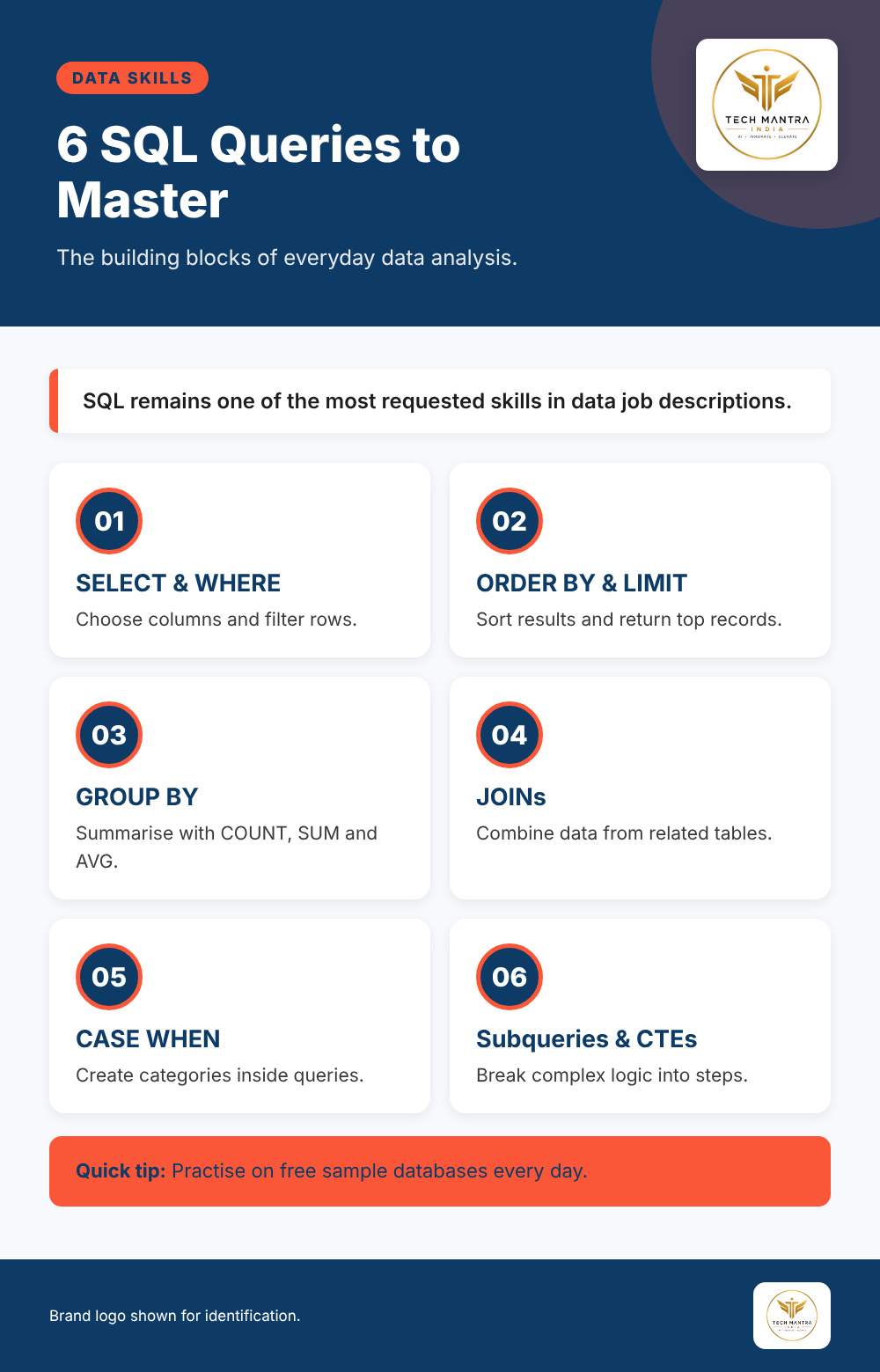
<p>SQL is the language used to ask questions of databases, and it appears in a large share of data analyst job descriptions. This infographic highlights six query patterns that form the foundation of everyday analysis.</p>
<p>Start with SELECT and WHERE to choose columns and filter rows, then use ORDER BY and LIMIT to sort results and find top records. Learners on a <u><a href="https://www.techmantraindia.org/courses/data-analytics-course-jaipur-rajasthan">data analytics course in jaipur</a></u> or elsewhere usually practise these on sample sales and customer tables.</p>
<p>GROUP BY with COUNT, SUM and AVG turns thousands of rows into clear summaries. JOINs combine related tables, such as orders with customers. Students at an <u><a href="https://www.techmantraindia.org/">it training center in jaipur</a></u> often find JOINs the most important concept to practise until it becomes natural.</p>
<p>Use aliases to keep column names readable in reports.</p>
<p>CASE WHEN creates categories inside queries, such as grouping customers by spending level. Subqueries and common table expressions break complex logic into readable steps. Trainers at a good <u><a href="https://www.techmantraindia.org/">it training institute in jaipur</a></u> encourage learners to write queries daily using free sample databases. Learn the order in which SQL clauses are processed.</p>
<p>Read query results carefully, check totals against expectations and practise explaining what each query does in plain language. Save this cheat sheet and keep practising.</p>